





Damask vs Satin vs Taffeta Woven Labels: Weaves Compared

Damask, satin and taffeta are the three main weaves for woven labels, and choosing between them is one of the first decisions when you order custom woven labels. The weave sets how sharp your logo looks, how soft the label feels and how the label behaves in washing. This guide compares damask vs satin vs taffeta woven labels: how each weave is built, what thread density and resolution mean in practice, how each one feels and where each one works best.
How a woven label is built
Every woven label has two thread systems. The warp runs lengthwise on the loom and usually forms the base colour of the label. The weft is shot across the warp, one pick at a time, and the jacquard mechanism decides for every single warp thread whether it lifts above or stays below each weft pick. Those decisions draw the logo.
Two values define the quality of the result:
- Weft yarn thickness, expressed in denier. A thinner yarn allows more picks in the same length of label.
- Pick density, the number of weft threads per centimetre or per inch. More picks mean smaller steps between threads, and therefore finer curves, smaller text and smoother outlines.
Think of picks as the pixels of a woven label. A high density is like a high screen resolution: more detail fits into the same area. The weave structure – damask, satin or taffeta – determines how those threads interlace and therefore how the surface looks and feels.
Damask woven labels
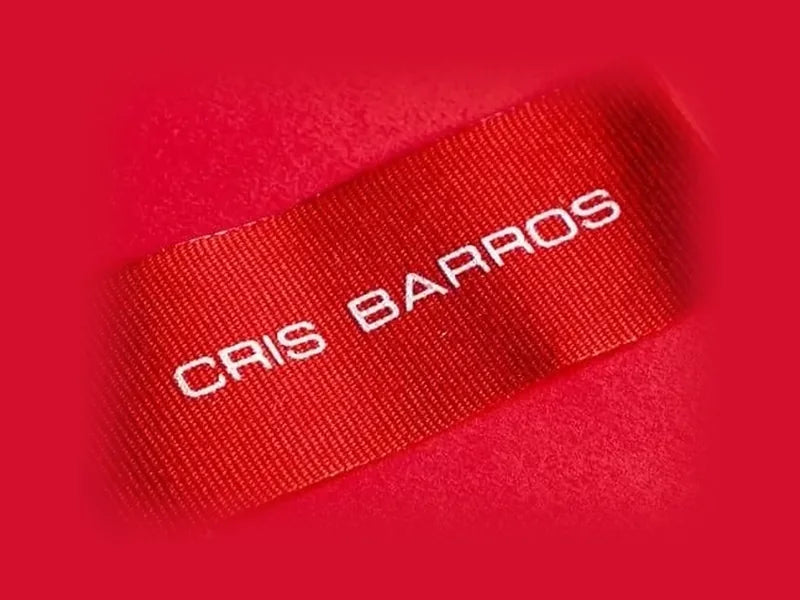
Damask is the most widely used weave for brand labels. It combines a fine weft yarn, commonly a thin polyester of around 50 denier, with a high pick density. The result is a thin, flat and flexible label with a smooth, slightly matt surface and crisp detail.
Damask reproduces small text, thin lines and detailed logos well, and it stays soft enough for neck labels in most garments. It is also very durable: the dense structure resists washing, abrasion and fraying. For extremely small text, fine serif fonts or detailed crests, a high-definition (HD) damask uses an even finer yarn and a higher density.
Where damask works best
- Main brand labels in shirts, dresses, jackets, knitwear and trousers
- Logos with fine detail, small lettering or several colours
- Size labels and small logo labels where space is limited
- Premium collections where the label should look precise
Satin woven labels
In a satin weave, threads float over several crossing threads before they interlace. These long floats reflect light, which gives satin its characteristic sheen and its very smooth, soft hand feel. A satin woven label usually has a satin ground with the logo woven in a contrasting weft.
The same floats that make satin glossy also make it slightly less precise. Thin lines and small letters lose a little sharpness, so satin designs work best with bold lines and generous text sizes. Satin labels are thicker and more fluid than damask and feel luxurious against the skin.
Do not confuse satin woven labels with printed satin labels. A printed satin label is a ready-woven satin tape with the design printed on the surface; a satin woven label has the design woven in. Our comparison of woven vs printed labels explains when printing is the better choice.
Where satin works best
- Lingerie, nightwear, evening wear and bridal garments
- Babywear and garments for sensitive skin, where softness comes first
- Simple wordmarks and bold logos that benefit from the shine
- Gift items, scarves and accessories with a soft, elegant feel
Taffeta woven labels
Taffeta labels use a simpler, plain-style interlacing with a coarser weft and a lower pick density. The structure is firm and crisp, with a slightly ribbed surface. Taffeta weaves faster on the loom, which makes it an economical option for large runs and for labels that carry simple information.
Because of the lower density, taffeta suits bold logos, simple text and clear shapes rather than fine detail. The firmer hand means it is not the first choice for labels touching the neck, but it performs very well in positions where stiffness is not noticed or is even useful.
Where taffeta works best
- Workwear, uniforms and promotional textiles
- Bags, home textiles and accessories
- Simple wordmarks, codes and information labels
- High-volume basics where cost efficiency matters
Damask vs satin vs taffeta: comparison
| Property | Damask | HD damask | Satin | Taffeta |
|---|---|---|---|---|
| Weft yarn | Fine (around 50 denier) | Finer than standard damask | Fine to medium, long floats | Coarser |
| Pick density | High | Very high | Medium to high | Low to medium |
| Detail / resolution | Very good | Excellent, micro text | Good for bold designs | Basic, bold shapes |
| Surface | Smooth, slightly matt | Smooth, slightly matt | Glossy | Crisp, slightly ribbed |
| Hand feel | Thin, soft, flexible | Thin, soft, flexible | Very soft, fluid | Firm, stiffer |
| Durability | Excellent | Excellent | Good; floats can snag | Very good |
| Typical uses | Main brand labels | Detailed logos, small labels | Lingerie, babywear, luxury | Workwear, bags, basics |
Resolution in practice: what fits on your label
The weave choice and the label size work together. A detailed crest that looks perfect on a 50 × 20 mm HD damask label can turn into a blur on a 15 mm wide taffeta label. Before choosing the weave, look at the smallest element in your artwork – the thinnest line, the smallest letter, the narrowest gap – and match it to the quality.
As a rule of thumb, HD damask is for micro detail, standard damask for most logos and text, satin for bold and elegant designs, and taffeta for simple wordmarks. Minimum text heights and line widths for each quality are listed in our woven label design tips, together with advice on simplifying logos for small sizes.
Tip: if you are unsure, order a physical sample of your logo in two qualities, for example damask and satin. Seeing the same design side by side in the actual garment answers the question faster than any description.
Feel, thickness and comfort
Comfort depends on the weave, but also on the yarn, the finishing and the edges. Damask labels are thin and flexible, which keeps them unnoticed in most garments. Satin is the softest on the skin, although slightly thicker. Taffeta is the firmest.
Several finishing steps change the hand feel further. A softening finish relaxes the woven structure; ultrasonic cutting seals the edges without a hard bead; and the right fold hides the cut ends inside the seam. Our guide to label edge finishes shows how the edge affects comfort as much as the weave does.
Colours and yarns
All three weaves are commonly produced in polyester, which holds colour well and survives repeated washing. Weft colours are matched to Pantone references from our yarn range; most designs use two to four colours, and damask can carry more. Metallic gold and silver yarns can be added to damask and satin for accents. For sustainability goals, recycled polyester yarns are available for many qualities, see recycled GRS labels. Labels can also be supplied OEKO-TEX Standard 100 certified.
How to choose the right weave
- Check the smallest detail in your logo. Fine detail points to damask or HD damask.
- Consider the garment. Close to the skin and delicate fabric: satin or soft damask. Outerwear, bags and workwear: damask or taffeta.
- Decide on the look. Matt and precise is damask; glossy and fluid is satin; crisp and practical is taffeta.
- Think about volume. For large runs of simple labels, taffeta is efficient; for a brand label that defines the product, damask is the safe standard.
- Confirm with a sample before bulk production.
Ordering woven labels
Send us your logo as a vector file with the label size, fold and garment type. Our express label design team recommends the weave and sends a digital proof typically within 24–48 h. The minimum order is typically 1,000 pcs per design, and production typically takes 10–20 working days after approval, with delivery across Europe. See all qualities in our woven labels collection.
Damask, satin or taffeta? A dedicated contact person supports you at every step and can send samples of each weave. Request a quote for your woven labels.
Frequently asked questions
What is the difference between damask and taffeta labels?
Damask uses a fine weft yarn and a high pick density, so it shows fine detail and feels thin and soft. Taffeta uses a coarser yarn and lower density, giving a firmer label for bold, simple designs.
Are satin woven labels softer than damask?
Yes, satin is usually the softest and smoothest weave because of its long floating threads. It is slightly thicker and less precise than damask, so bold designs work best.
What is HD damask?
High-definition damask uses an even finer weft yarn and a higher pick density than standard damask. It is used for micro text, fine serif fonts and detailed logos.
Which woven label weave is most durable?
Damask and HD damask are the most durable thanks to their dense structure. Taffeta is also very robust; satin floats can snag on rough surfaces.
Can I see samples of different weaves?
Yes. We can produce physical samples of your logo in different weaves so you can compare look and feel in your garment before bulk production.
More guides

Label Edge Finishes: Ultrasonic, Laser, Heat Cut and Woven Edges
Ultrasonic, laser, hot knife, woven selvedge, merrow or folded: how each label edge finish is made, how it feels on the skin and where to use it.
Read article
Labels for Knitwear: Soft Labels, Placement and Care for Wool and Cashmere
Knitwear needs labels that are soft, flexible and correctly placed: a guide to label materials, folds, placement and care content for wool and cash...
Read article
Labels for Caps and Hats: Woven Labels, Patches, Badges and Size Labels
Woven labels in the sweatband, patches on the front, metal plates and silicone badges, size labels for fitted caps: how to brand caps, beanies and ...
Read articleTell us about your labels
Send the label type, size, quantity and your deadline. We usually reply within one working day with a price and a recommendation.
- Usual MOQ 1,000 pcs per design
- Samples before production
- Production 10–20 working days
- Delivery across Europe