





Label size guide
Standard sizes in mm for every label type, with fold allowances, board weights and thicknesses – a reference for planning your order.
This guide collects the sizes we produce most often for every label type, in millimetres. Width is always the tape or label width; length is measured along the tape. Unless stated otherwise, sizes are the finished, visible dimensions after folding and sewing. All figures are typical starting points – we can make custom sizes within the limits of each technique. For help deciding, read how to choose a label size.
Measure an existing label you like, or the space where the label will sit (neck seam, side seam, waistband), and leave at least 2–3 mm free on each side of the text.
Woven labels
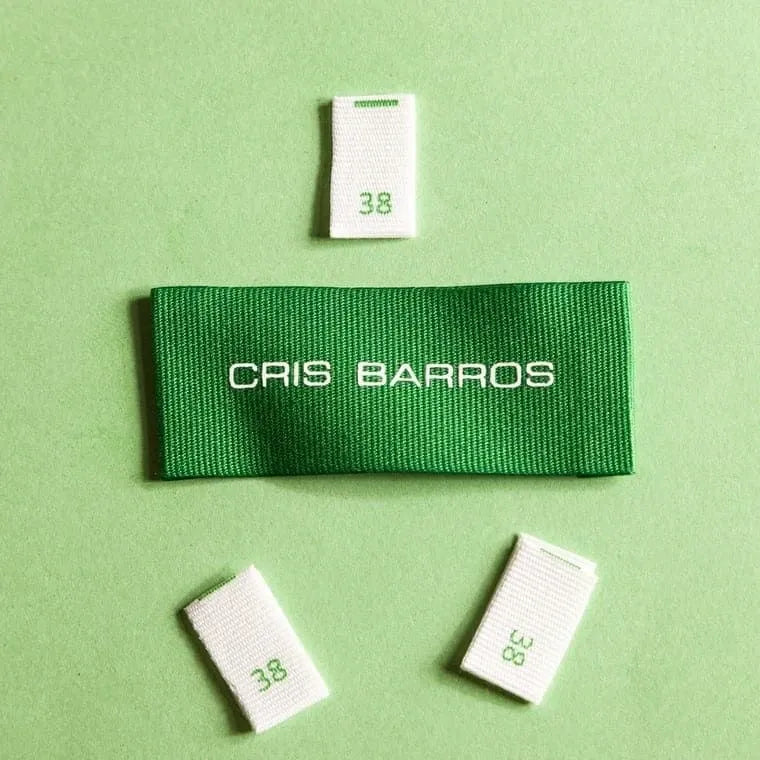
Woven labels are produced on tapes of fixed widths, so width choices are more limited than length. Damask allows the finest detail; satin and taffeta give a softer or crisper hand. Fine text needs a capital height of roughly 1.5–2 mm or more.
| Width (mm) | Common lengths (mm) | Typical use |
|---|---|---|
| 10 | 30–50 | Small loop tabs, size tabs, sleeve flags |
| 15 | 40–70 | Size tabs, small brand labels, side-seam flags |
| 20 | 40–80 | Neck labels for T-shirts and kidswear |
| 25 | 50–90 | Standard neck and inside brand labels |
| 30 | 50–100 | Neck labels for shirts, outerwear, knitwear |
| 35–40 | 60–110 | Jackets, coats, bags, home textiles |
| 50–60 | 70–120 | Large brand labels, blankets, towels, bags |
Fold types: finished size and cut length
The fold determines how much tape is consumed. Cut length is what we weave and cut before folding; the allowances below are typical and are confirmed on your proof. See label fold types explained for diagrams and use cases.
| Fold type | Example finished size (mm) | Typical cut length (mm) | How it is sewn |
|---|---|---|---|
| Straight / flat cut | 25 × 50 | 50 | Stitched on all four sides or two ends |
| End-fold | 15 × 50 | 62–66 (finished + 6–8 mm per end) | Both short ends folded under, sewn flat |
| Centre-fold | 20 × 50 | 110–114 (2 × finished + 10–14 mm seam allowance) | Folded in half, open ends caught in a seam |
| Loop fold | 15 × 25 visible loop | 60–64 (2 × visible + 10–14 mm) | Ends brought together and sewn in as a loop or hanger |
| Mitre fold | 20 × 60 | About 100 (finished length + 2 × width) | Ends folded at 45°, label hangs from the seam |
| Manhattan / booklet | 30 × 40 per panel | Panel length × number of panels + 10 mm | Several panels folded and sewn as a booklet |
Printed fabric labels
Printed labels are made on satin, cotton, polyester or Tyvek tapes. Printing allows smaller text and photographic detail than weaving and suits continuous tapes cut to almost any length.
| Tape width (mm) | Common lengths (mm) | Material options |
|---|---|---|
| 10–15 | 30–60 | Satin, polyester tape |
| 20–25 | 40–90 | Satin, cotton, polyester |
| 30–35 | 50–120 | Satin, cotton, nylon taffeta |
| 40–50 | 60–150 | Satin, cotton, Tyvek |
| Continuous ribbon | Rolls, cut by you | Satin or cotton tape with repeat print |
Care labels
Care labels carry the fibre composition required under Regulation (EU) No 1007/2011, care symbols to ISO 3758 and, often, several languages. The more languages and information, the longer the label – or a booklet. See EU care label requirements.
| Tape width (mm) | Typical lengths (mm) | Content capacity |
|---|---|---|
| 20 | 40–80 | Composition and symbols, 1–2 languages |
| 25 | 40–100 | Composition, symbols, origin, 2–4 languages |
| 30 | 50–120 | Standard adult garments, 4–8 languages |
| 35 | 60–130 | Multilingual text, article/batch codes |
| 40 | 70–150 | Extensive text, workwear data, QR code |
| 50 | 80–150 | Home textiles, technical products |
| Booklet care labels | Typical spec |
|---|---|
| Panel size | 25 × 40 to 40 × 70 mm |
| Number of panels | 2–8 (front and back printed) |
| Languages | Up to 20+ depending on text length |
| Fixing | Sewn at the top edge into the side seam |
Size labels
Size labels are small woven or printed tabs, or size ribbons printed on continuous tape. Loop-fold tabs are often inserted next to the main label.
| Format | Finished size (mm) | Notes |
|---|---|---|
| Flat tab | 10 × 15, 12 × 20 | Single size code, sewn under main label |
| Square tab | 15 × 15 | Two-digit sizes, kidswear |
| Rectangular tab | 15 × 20, 15 × 25 | Size plus fit or colour code |
| Loop-fold tab | 10 × 15, 12 × 20 visible | Sewn into seam as a loop |
| Size ribbon on tape | 10–15 mm wide, cut 20–40 | Repeat print, cut to length |
Hang tags
Hang tags are cut from board, so shape and size are free; the sizes below fit standard strings and retail displays. Heavier board feels more premium and holds a string better.
| Size (mm) | Typical use |
|---|---|
| 40 × 70 | Accessories, socks, kidswear |
| 50 × 90 | Standard apparel tag |
| 55 × 85 | Business-card format, folded or flat |
| 50 × 100 | Apparel with price and barcode area |
| 60 × 100 | Outerwear, denim, more product information |
| 90 × 50 | Landscape tags, bags, home textiles |
| Ø 50–60 round, die-cut | Brand shapes, gift and premium products |
| Option | Typical spec |
|---|---|
| Board weight | 300–600 g/m² (300–350 standard, 400–600 premium or laminated) |
| Hole / eyelet | Hole 4–5 mm; metal eyelet optional |
| String length | 15–20 cm, open or with knot |
| Fastening | Cotton or waxed string, plastic seal tags, lock pins |
| Finishes | Matt or gloss laminate, hot-foil, embossing, spot UV |
Silicone labels
Silicone and rubber labels are moulded, so a mould is made for each design. Thickness determines how pronounced the 3D effect is.
| Size (mm) | Thickness (mm) | Typical use |
|---|---|---|
| 20 × 20 | 1–2 | Small logo badges, caps, sleeves |
| 30 × 30 | 1–2.5 | Sportswear, bags |
| 40 × 20 | 1–2 | Waistbands, cuffs |
| 50 × 20 | 1–2.5 | Outerwear, backpacks |
| 50 × 30 | 1.5–3 | Jackets, workwear |
| 60 × 40 | 2–3.5 (3D up to ~4) | Large 3D logos |
Leather labels and jeans patches
Leather labels are made in genuine or faux leather, debossed, printed or laser-engraved, and sewn or riveted.
| Size (mm) | Thickness (mm) | Typical use |
|---|---|---|
| 30 × 20 | 1–1.5 | Knitwear, beanies, small accessories |
| 40 × 25 | 1–1.5 | Sleeves, pockets, bags |
| 50 × 30 | 1–2 | Jackets, bags |
| 60 × 40 | 1–2 | Outerwear, luggage |
| 70 × 50 | 1.5–2 | Jeans back patch |
| 80 × 60 | 1.5–2 | Jeans back patch, workwear |
| 90 × 60 | 1.5–2 | Large jeans patch, bags |
Metal labels and emblems
Metal labels are made in zinc alloy, brass, aluminium or stainless steel, all nickel free; finishes include a nickel-look, gold-look, gunmetal or matt effect.
| Type | Size (mm) | Thickness (mm) | Attachment |
|---|---|---|---|
| Logo plate | 20 × 5 | 0.5–1 | Prongs or adhesive |
| Logo plate | 30 × 8 | 0.5–1.2 | Prongs, stitch holes |
| Logo plate | 40 × 10 | 0.8–1.5 | Prongs, stitch holes, rivets |
| Logo plate | 50 × 15 | 0.8–1.5 | Stitch holes, rivets, screws |
| Emblem / badge | Ø or width 15–40 | 1–1.5 | Prongs, pins, adhesive |
Patches
Patches can be embroidered, woven or chenille. Woven patches handle finer detail at small sizes than embroidery.
| Size (mm) | Edge | Backing |
|---|---|---|
| 50 × 50 | Merrowed or heat-cut | Sew-on, iron-on |
| 60 × 40 | Heat-cut or laser | Sew-on, iron-on, adhesive |
| 70 × 70 | Merrowed | Sew-on, hook-and-loop |
| 80 × 60 | Merrowed or laser | Sew-on, iron-on, hook-and-loop |
| 100 × 100 | Merrowed | Sew-on, hook-and-loop |
Heat transfer labels
Heat transfers replace sewn neck labels with a print applied by heat press – ideal for tagless comfort and sportswear.
| Size (mm) | Typical use |
|---|---|
| 30 × 30 | Small logos, kidswear |
| 40 × 40 | Tagless neck print |
| 50 × 50 | Tagless neck print with size and care symbols |
| 60 × 40 | Neck print with composition text |
| 80 × 60 | Back-neck or chest logo |
Stickers and packaging labels
Stickers are supplied on rolls or sheets for boxes, polybags and swing-tag barcodes.
| Shape | Size (mm) | Typical use |
|---|---|---|
| Round | Ø 30 | Seals, small logos |
| Round | Ø 40 | Box and bag seals |
| Round | Ø 50 | Packaging branding |
| Rectangle | 50 × 30 | Barcode, price, size stickers |
| Rectangle | 70 × 40 | Carton and polybag labels |
| Rectangle | 100 × 50 | Shipping cartons, product information |
For a QR code that will link to a Digital Product Passport, keep a quiet zone around the code and allow at least about 15 × 15 mm for the code itself; see QR / DPP labels. Real examples of all these sizes appear in our Labels 2026 catalogue.
Not sure which size fits? Send us the garment type and label position and we will recommend dimensions and a fold. Request a quote.
Frequently asked questions
Are the sizes in the guide finished or cut sizes?
Unless stated otherwise, they are finished, visible sizes after folding. The fold table shows the typical cut length we produce for each fold type.
Can you make sizes that are not in the tables?
Yes. The tables show common sizes; we can produce custom widths, lengths and shapes within the limits of each technique.
How much extra length does a centre-fold label need?
A centre-fold label is cut to roughly twice the finished length plus about 10–14 mm for the seam. We confirm the exact figure on your proof.
What is the most common hang tag size?
For apparel, 50 × 90 mm and 50 × 100 mm are the most common, usually on 300–350 g/m² board with a 4–5 mm hole and a 15–20 cm string.
How wide should a care label be?
Most garments use 25–35 mm wide care tape. Choose 40 mm or a booklet if you need many languages or extra data such as a QR code.
Tell us about your labels
Send the label type, size, quantity and your deadline. We usually reply within one working day with a price and a recommendation.
- Usual MOQ 1,000 pcs per design
- Samples before production
- Production 10–20 working days
- Delivery across Europe