





Large Woven Labels: Formats from 8 × 8 to 20 × 20 cm and Where to Use Them
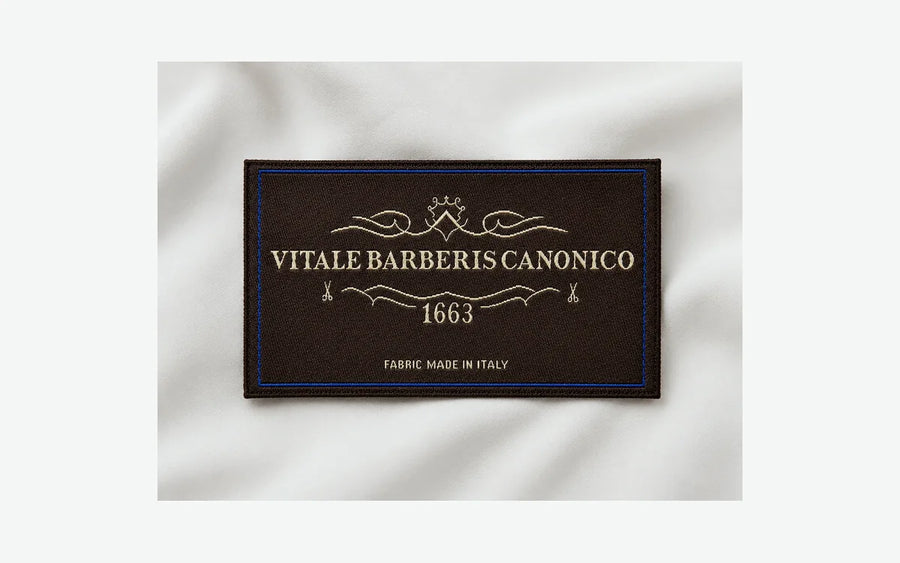
Large woven labels are the statement pieces of the label world. A standard neck label is 15–25 mm wide; a large woven label starts at about 80 × 80 mm and can reach 200 × 200 mm or long rectangular formats of 300 mm and more. At this size the label is no longer hidden inside a seam: it becomes a visible part of the product on a sofa, a throw blanket, a tote bag or the back of a jacket. This guide explains which formats are common, where big woven labels work best, what the loom allows and how density, borders and sewing affect the result.
What counts as a large woven label
There is no official threshold, but in production terms a woven label becomes "large" when it needs a wide jacquard loom set-up rather than a narrow tape loom, and when its area makes yarn use and weaving time noticeably higher. In practice that means anything from about 60 mm on both sides, and anything longer than about 150 mm. Large labels are woven on broad looms in many repeats across the width, then cut and finished one by one. Our woven labels are produced this way in our own production in Bulgaria, from small neck labels to big statement formats.
Common formats and their uses
| Format (mm) | Shape | Typical uses |
|---|---|---|
| 80 × 80 | Square | Cushions, small bags, caps (back), children's blankets |
| 100 × 100 | Square | Throw blankets, tote bags, mattresses, sofas |
| 120 × 120 | Square | Blankets, beach towels, rucksacks, merchandise |
| 150 × 150 | Square | Jacket backs, large bags, promotional textiles |
| 200 × 200 | Square | Jacket backs, flags, banners, wall textiles |
| 50 × 150 to 60 × 200 | Rectangle | Blanket edges, scarves, bag straps, sofa sides |
| 80 × 120 to 100 × 150 | Rectangle | Home textiles, workwear backs, event merchandise |
| Custom shape | Cut to outline | Logo shapes, badges, emblems |
These are starting points, not fixed sizes. Any width and length within the loom limits can be woven; use our label size guide to compare proportions against your product.
Where large woven labels work best
Furniture and home textiles
On sofas, armchairs and mattresses, a label of 80–150 mm is readable from across the room and matches the scale of the furniture. On throws and blankets, a large square label in one corner or a long rectangle along the hem is the classic branding position. See our guides to labels for furniture and upholstery and labels for home textiles for placement details.
Bags and accessories
Tote bags, rucksacks and weekend bags carry large woven labels on the front panel or inside the main compartment. A sewn-on label of 100 × 100 mm or a long strap label turns a plain bag into a branded product.
Jacket backs and workwear
A woven label of 150–200 mm on the back of a jacket or work vest is an alternative to embroidery. It is lighter, keeps fine detail and is sewn on as one piece. For very bold, raised looks, a patch may be the better choice; see our patches.
Merchandising and events
Clubs, festivals and promotional companies use large woven labels as collectable badges, banner labels and branded panels on merchandise. A woven finish feels more permanent than a print and stays legible after many washes.
Loom width and technical limits
Woven labels are made on jacquard looms where each warp thread can be lifted individually to form the design. The available width depends on the loom set-up: broad label looms weave many labels side by side, and a single very wide label uses a larger share of that width. In practice, widths of up to about 200 mm are produced regularly, and the length is set by the repeat, so long rectangles are possible. Labels larger than this are usually split into panels or made as woven fabric by the metre.
Two limits matter for design:
- Number of colours: most woven labels use up to 8–10 weft colours plus the warp colour. More colours in a large area make the label heavier and stiffer.
- Weft floats: large single-colour areas create long floating threads on the back. We bind them with a tie-down structure so they do not snag, which slightly changes the surface texture.
Density, picks and quality
The resolution of a woven label depends on the number of weft threads per centimetre (often called picks). Damask weaves use fine yarns and a high pick density, giving sharp letters and smooth curves. Satin weaves give a lustrous surface with slightly softer detail, and taffeta is the most economical and the least detailed. For large labels, density has two effects: it improves detail, and it increases weaving time and weight. Many large labels use damask for the logo area and a simpler structure for the background, which keeps the label flexible. Our article damask vs satin vs taffeta explains the weaves in detail.
Tip: on a large label, small text does not need to be tiny. Scale fonts with the label: a 150 mm label with 3 mm text looks empty, while 8–12 mm text reads cleanly and weaves well.
Borders, edges and finishing
Large labels need firm edges because the long sides are visible and handled often.
- Woven border: a frame of 2–5 mm in a contrasting colour woven into the design defines the label and gives the sewing line a clear guide.
- Ultrasonic or heat cut: sealed edges that do not fray, suitable for straight and shaped outlines.
- Laser cut: precise for custom shapes and logo outlines.
- Merrow edge: an overlocked border, typical for badge-style labels.
- Folded edges: all four sides folded under for a soft, tailored look on blankets and bags.
- Back coating: a light coating on the back keeps big labels flat and stable during sewing; iron-on backing is possible for positioning before stitching.
Sewing large labels
A large label must be sewn evenly on all sides so it does not ripple or curl. Stitch 2–3 mm from the edge, or along the woven border, and use thread that matches the border colour. On stretchy fabrics, add a lightweight interlining behind the label. On thick materials such as blankets and upholstery, a folded-edge label sewn on all sides looks neat and hides the cut edges. For heavy products, sewing the label to a panel before assembly is faster than sewing it on the finished item.
What drives the cost of large woven labels
We do not publish prices, because every large label is quoted to its design, but the logic is simple. Cost grows with the label area, because it uses more yarn and more loom time. It also rises with pick density, the number of colours and special finishes such as folded edges or laser cutting. Quantity matters as well: set-up work is shared across the order, so larger runs bring the unit cost down. If you want to control the cost, keep the background structure simple, limit the colours to what the design truly needs and choose a format that cuts efficiently across the loom width. Our express label design team can suggest these adjustments on your artwork before a proof is made.
MOQ, samples and lead time
The minimum order for large woven labels is typically 1,000 pcs per design. A digital proof is usually ready within 24–48 h, and a physical sample can be woven so you can check scale, colour and feel on your product. After approval, production typically takes 10–20 working days, with delivery across Europe.
Planning a big woven label for a blanket, bag or jacket back? Send us your logo and the product size; a dedicated contact person supports you at every step, from format to sewing advice. Request a quote for your large woven labels.
Frequently asked questions
How big can a woven label be?
Widths of up to about 200 mm are produced regularly, and long rectangles of 300 mm and more are possible because the length is set by the repeat. Larger pieces are usually made as panels.
Where are large woven labels used?
On sofas, mattresses, blankets and throws, tote bags and rucksacks, jacket and workwear backs, and on merchandise for clubs, events and promotions.
Which weave is best for a large woven label?
Damask gives the sharpest detail, satin a lustrous surface and taffeta the most economical result. Many large labels combine a damask logo with a simpler background structure.
How should a large woven label be sewn on?
Stitch evenly on all sides 2–3 mm from the edge or along a woven border. On stretchy fabrics add a light interlining, and on thick materials use a folded-edge label.
What is the minimum order for large woven labels?
Typically 1,000 pcs per design. Production usually takes 10–20 working days after sample approval, with delivery across Europe.
More guides

Damask vs Satin vs Taffeta Woven Labels: Weaves Compared
How damask, HD damask, satin and taffeta woven labels differ in thread density, detail, hand feel and durability, and which weave suits your garments.
Read article
Label Edge Finishes: Ultrasonic, Laser, Heat Cut and Woven Edges
Ultrasonic, laser, hot knife, woven selvedge, merrow or folded: how each label edge finish is made, how it feels on the skin and where to use it.
Read article
Labels for Knitwear: Soft Labels, Placement and Care for Wool and Cashmere
Knitwear needs labels that are soft, flexible and correctly placed: a guide to label materials, folds, placement and care content for wool and cash...
Read articleTell us about your labels
Send the label type, size, quantity and your deadline. We usually reply within one working day with a price and a recommendation.
- Usual MOQ 1,000 pcs per design
- Samples before production
- Production 10–20 working days
- Delivery across Europe